Production support schemes are gradually giving way to consumption and emissions-reduction obligations in several European countries, opening new prospects for the renewable-gas market.
The European biomethane market is undergoing changes in the mechanisms driving its development. Alongside traditional public support schemes for production, regulatory obligations requiring certain sectors to incorporate renewable gases or reduce the emissions intensity of their activities are becoming increasingly important.
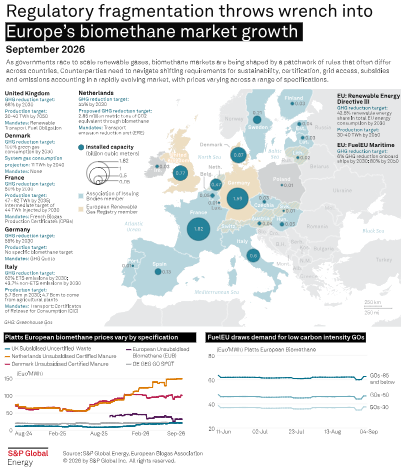
S&P Global Energy analyses this evolution in its article European biomethane players pivot toward compliance markets, published on 10 September 2026. The analysis highlights how several European countries are shifting toward compliance-based models (compliance markets), where biomethane demand is linked to meeting regulatory targets.
This shift marks an evolution from models that primarily subsidise production. Under consumption-based obligation schemes, energy suppliers and other market participants must meet specific targets by incorporating renewable fuels or reducing the emissions associated with their activities.
The article identifies three examples illustrating this trend across Europe.
In France, the Biogas Production Certificates (Certificats de Production de Biogaz, CPB) scheme establishes obligations for gas suppliers serving residential and tertiary-sector customers. Eligible producers can generate certificates that help meet these obligations, creating a demand mechanism linked to biomethane production.
In Germany, greenhouse gas reduction quotas for transport fuels allow different renewable alternatives, including biomethane, to count towards compliance, provided they meet specific sustainability and emissions reduction requirements. In addition, the new framework for heating systems introduces progressively increasing minimum shares of renewable gases for certain installations.
Meanwhile, the Netherlands is developing a renewable gas blending obligation for the gas grid, under which suppliers will have to contribute to achieving annual emissions reduction targets. The mechanism is scheduled to take effect in 2027, with targets gradually increasing through 2031.
These examples show how regulatory obligations can generate demand and create new commercial opportunities for biomethane. However, S&P Global also points out that fragmented national frameworks, differences in certification systems and grid access conditions continue to hinder the development of an integrated European market.
New technological pathways to respond to market developments
These mechanisms reinforce the need to expand biomethane production capacity and diversify the technologies available to produce it. Demand evolution must be matched by solutions that can use different feedstocks and provide alternative supply options for various end-use sectors.
HyFuelUp proposes combining gasification of residual biomass and other low-value resources, including digestates from anaerobic digestion plants, with gas-cleaning and methanation processes. By flexibly incorporating renewable hydrogen, the project aims to optimise the conversion of the resulting gases into methane.
One of HyFuelUp’s objectives is to demonstrate this production pathway’s potential to supply bio-LNG to sectors such as heavy-duty road transport and maritime transport, where renewable gaseous fuels can offer an alternative to reduce emissions associated with fossil fuel use.
The evolution of compliance mechanisms in Europe, particularly those related to transport emissions reduction, provides relevant context for the development of these fuels. Their effective integration will nevertheless depend on the sustainability, certification and eligibility requirements established under each regulatory framework.
S&P Global’s analysis highlights that biomethane market growth depends not only on increasing production capacity, but also on consolidating mechanisms that generate demand and facilitate commercialisation. In parallel, projects such as HyFuelUp are working to expand the available technological options and contribute to the development of new value chains for renewable gases
Read the full publication:
European biomethane players pivot toward compliance markets | S&P Global