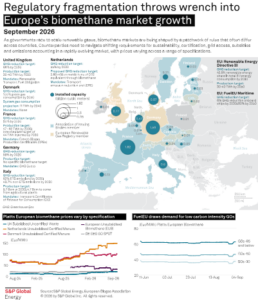
Administrative procedures, investment uncertainty, difficulties in accessing the market, and a lack of recognition of certain environmental benefits continue to affect the deployment of renewable gases.
The development of biogas and biomethane in Europe depends not only on resource availability and technological advances. The regulatory and administrative framework also shapes their deployment, influencing the development of new facilities, investment viability, and the marketing of renewable gases.
The European Biogas Association (EBA) addresses this in its publication Regulatory barriers to biogas development in Europe, released in October 2026. The document identifies five areas where obstacles to the sector’s development persist and presents recommendations and examples of initiatives across Europe aimed at supporting its growth.
Five areas shaping the development of the sector
The first area concerns permitting and planning procedures. Biogas and biomethane projects may require permits covering several fields, including energy, waste, emissions, agriculture, water and construction. Administrative fragmentation and poor coordination between authorities can extend approval timelines. The EBA proposes establishing one-stop shops, digitising procedures, and simplifying permitting requirements for existing facilities.
The second area relates to investment and market certainty. The lack of stable regulatory signals and dedicated national strategies makes long-term planning harder and can undermine investor confidence. The association calls for stronger policy commitments, national biomethane strategies, and greater recognition of biomethane’s role in European energy security frameworks.
Market integration represents another challenge. Differences across countries in grid connection requirements, associated costs, and certification systems make biomethane marketing harder, particularly for small-scale and decentralised producers. Harmonising grid access rules and developing compatible guarantees of origin systems are among the measures highlighted.
The fourth area focuses on climate recognition and carbon accounting. The EBA notes that certain environmental benefits associated with biomethane are not consistently accounted for across European frameworks. These include avoided methane emissions, biogenic CO₂ capture, and nutrient recovery through digestate use. To address this, the association proposes harmonising calculation methodologies and establishing common criteria for recognition and traceability.
Finally, the publication examines the challenges involved in stimulating demand for biogases and co-products. Although these gases can support the energy transition in sectors such as transport, heating, and industry, existing frameworks still have limitations that hinder uptake. The EBA proposes strengthening renewable fuel targets in transport, facilitating long-term biomethane offtake agreements and improving the recognition of guarantees of origin.
The document also highlights initiatives implemented in different European countries that offer potential ways forward, including digital permitting systems, incentives for manure treatment, biomethane supply agreements and support schemes for biogenic CO₂ capture.
New technologies to diversify biomethane production
Regulatory developments need to go hand in hand with technological advances that expand the possibilities for renewable gas production. Diversifying feedstocks and conversion pathways is also important to better use resources whose valorisation potential remains largely untapped.
HyFuelUp is working in this direction. The project combines gasification of residual biomass and other low-value resources, including digestates from anaerobic digestion plants, with gas cleaning and methanation processes. The latter incorporates renewable hydrogen flexibly to promote the conversion of the resulting gases into methane.
The project integrates these technologies into a pre-commercial-scale demonstration production chain, with its main facility located in Tondela (Portugal). Its objective is to validate an alternative technological pathway that expands the available routes for biomethane production and enables the use of different biogenic resources.
In addition, HyFuelUp envisages the liquefaction and distribution of the biomethane produced as bio-LNG, with a particular focus on its use in heavy-duty road and maritime transport.
The EBA’s analysis highlights that developing biogas and biomethane in Europe requires progress on several fronts. Administrative simplification, regulatory stability, integrating renewable gases into markets, and recognising their environmental benefits must go hand in hand with developing new technological solutions.
Projects such as HyFuelUp support this process through innovation, developing alternative production pathways that broaden opportunities for residual biomass valorisation and renewable gas production.
Read the full EBA publication: Regulatory barriers to biogas development in Europe – European Biogas Association