
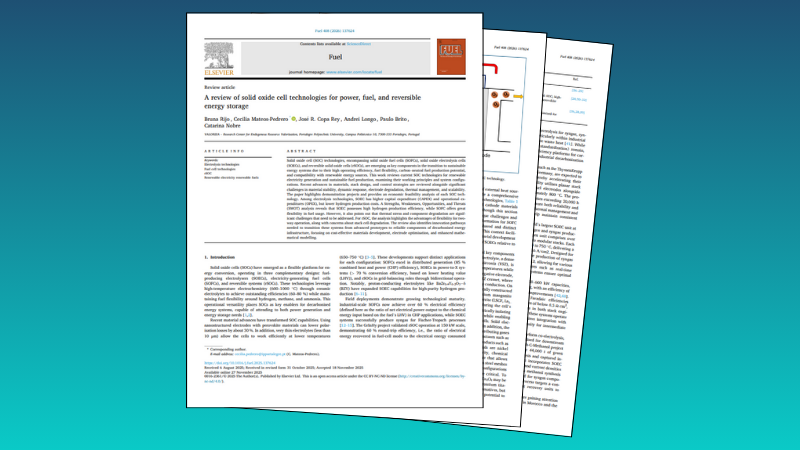
The HyFuelUp project is celebrating the publication of its third scientific article, on this occasion in Volume 408 of the journal Fuel (by Elsevier).
Entitled “A review of solid oxide cell technologies for power, fuel, and reversible energy storage“, it has been written by our colleague from Instituto Politécnico de Portalegre, Bruna Rijo, and her research team at VALORIZA – Research Center for Endogenous Resource Valorization: Cecilia Mateos-Pedrero, José R. Copa Rey, Andrei Longo, Paulo Brito and Catarina Nobre.
This review explores the state of Solid Oxide Cell (SOC) technologies for generating renewable electricity and producing sustainable fuels, outlining how they work and the ways they can be configured within energy systems.
It also looks at recent progress in materials research, stack design and control strategies, while addressing ongoing challenges such as material stability, slow dynamic response, electrode degradation, thermal management and the difficulty of scaling up.
The paper highlights real-world demonstration projects and offers an economic assessment of each SOC technology. Among electrolysis options, SOECs stand out: although they come with higher capital (CAPEX) and operational (OPEX) costs, they can deliver hydrogen at a lower cost. A SWOT analysis shows that SOECs achieve high hydrogen production efficiency, while SOFCs offer impressive flexibility in the types of fuel they can run on. However, the analysis also underscores the significant issues of thermal stress and component degradation. For rSOCs, the key advantage is their ability to switch between power generation and electrolysis, balanced against concerns about the long-term durability of stack cells.
Finally, the review outlines key innovation pathways needed to move these technologies from advanced prototypes to dependable elements of a decarbonised energy infrastructure. Priorities include developing cost-effective materials, improving electrode performance and strengthening mathematical modelling to support better system design.
This new milestone in the dissemination of the HyFuelUp project results demonstrates the consortium’s commitment and the advanced progress made in the research of the various working teams.