Europe’s biomethane sector is on a steady rise, yet it risks losing momentum. By the end of Q1 2025, installed production capacity reached 7 billion cubic metres (bcm) per year, marking a 9 % increase from 2024. While investor confidence remains high—€28 billion is earmarked for biomethane projects, slightly more than last year—growth is beginning to slow. The gap between ambition and delivery points to a clear need for stronger policy frameworks and binding targets to ensure the sector keeps pace.
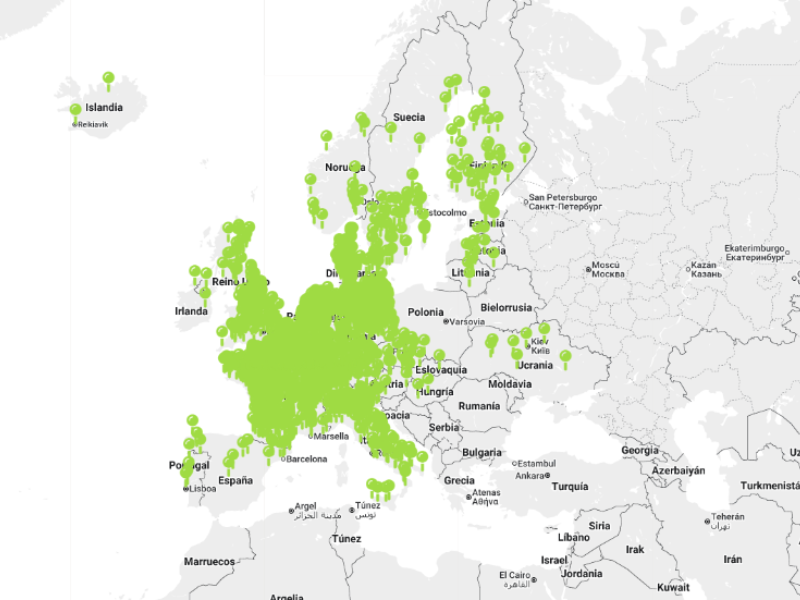
Biomethane, the renewable gas produced from organic waste, offers Europe a homegrown, circular alternative to fossil fuels. It can be used for heating, electricity, and transport, while also generating organic fertilisers and biogenic CO₂ as valuable by-products. The European Biogas Association (EBA), in its 2025 Biomethane Investment Outlook, projects that current investments could push capacity to 7.3 bcm/year by 2030, a 1 bcm rise from last year. Meanwhile, the number of operational plants grew from 1,548 to 1,678, with 165 new facilities launched, including 56 already active at the start of 2025.
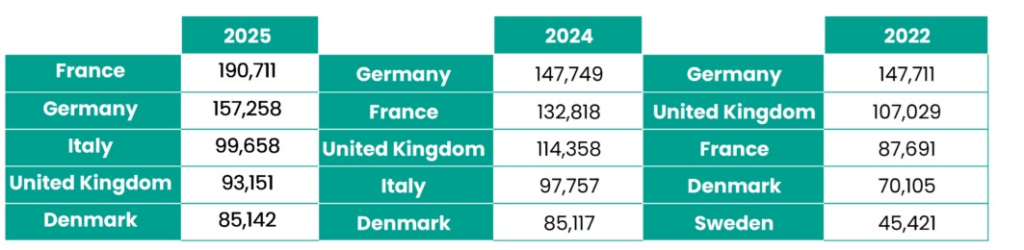
France has emerged as the new European leader in biomethane, surpassing Germany with a 21 % higher share of production and three times the number of plants. By contrast, the UK and Germany have seen stagnation, largely due to regulatory uncertainty, while Italy, the Netherlands, Denmark, and Sweden continue to contribute, albeit at a slower pace. Plant sizes vary dramatically: French installations are relatively small, averaging 251 Nm³/h, whereas Italy and Germany operate larger plants (727 and 605 Nm³/h respectively), and Denmark has fewer but enormous facilities, averaging 1,468 Nm³/h. Over 85 % of European biomethane plants are connected to the gas grid, with nearly half feeding distribution networks and 8% supplying transport infrastructure.
The potential of biomethane extends far beyond today’s production levels. The EU’s REPowerEU plan set a target of 35 bcm by 2030, signalling political ambition and boosting sector confidence. Looking further ahead, Europe could produce up to 150 bcm of biogases annually by 2050, alongside 177 million tonnes of organic fertilisers and 120 million tonnes of biogenic CO₂, offering a circular solution to energy security and climate challenges.
Harmen Dekker, CEO of the EBA, warns that these prospects will only be realised with clear political support. “Legal certainty, binding targets, and high-level commitment are essential to unlock the sector’s full potential,” he explains. Without this, Europe risks slowing progress in a field that could deliver clean energy, strengthen local economies, and reduce dependence on imported fossil fuels. Biomethane may still be a rising star in Europe’s green transition—but only if policy keeps up with ambition.
Source: European Biogas Association (EBA)